Missed your baby's vaccine? Catch-up schedule and what to do next
A missed dose almost never means starting the series again. Here is the age-wise catch-up guide, the handful of vaccines that have a real deadline, and the exact steps to take this week.
By Renish B, Founder
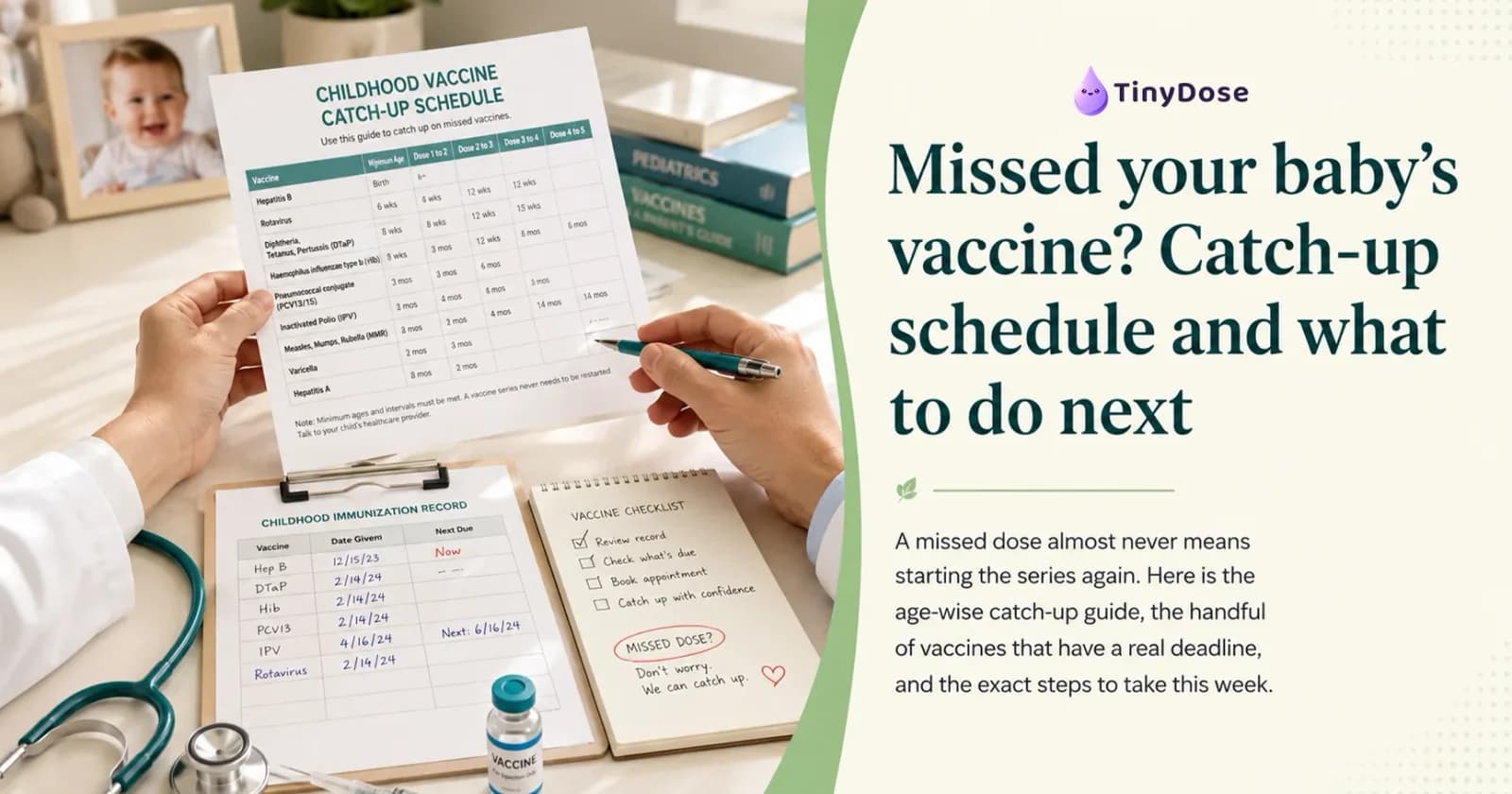
You almost certainly do not have to start over
The date on the card has passed. Maybe by ten days, maybe by four months. Either way you are now doing the thing every parent does, which is quietly wondering whether you have undone months of protection and whether the whole series has to begin again from scratch.
Here is the short answer, and it is the one most articles bury under three paragraphs of general advice. An interrupted schedule does not need to be restarted. Every dose your child has already received still counts. Your pediatrician picks up where the schedule stopped and continues from there.
That principle holds across the India UIP schedule, the IAP schedule most private clinics follow, and the WHO guidance both are built on. It is not a special exception being made for you. It is how these vaccines are designed to work.
What a delay does affect is the stretch of time your child spends unprotected. That is the real cost of a missed dose, and it is why catching up promptly still matters even though restarting is unnecessary.
This is general information written for parents, not medical advice. Your pediatrician makes the final call on your child's schedule.
Three rules that decide every catch-up plan
Nearly every question about a missed vaccine comes down to these.
Doses already given still count. Two of three Pentavalent doses done means you need the third, not another three.
There is no maximum gap, only a minimum gap. A four month delay between doses does not weaken what came before. But two doses given too close together can work less well, so your pediatrician spaces the catch-up doses properly rather than giving everything at once.
A small number of vaccines have a genuine age limit. This is the part that actually matters, and the part most general articles skip entirely. Most vaccines can be caught up well into childhood. A few cannot.
If you missed the birth doses
BCG, the Hepatitis B birth dose, and the polio birth dose (OPV-0) are given in the first days of life, usually before you leave the hospital. Home births and early discharges are the usual reasons these slip.
BCG can still be given later. Under the India UIP schedule it is given up to one year of age. Past that it is generally not part of routine catch-up, and your pediatrician decides based on your child's situation.
Hepatitis B has no such cutoff. If the birth dose was missed, the series simply starts later and still runs to three doses. The birth dose matters most when the mother is Hepatitis B positive, which is a situation to raise with your doctor immediately rather than at the next routine visit.
OPV-0 is an extra dose rather than a required one. Missing it does not change the rest of the polio schedule.
If you missed the 6, 10, or 14 week visits
This block is where most delays happen, because it is three visits inside eight weeks with a newborn at home.
The vaccines here are Pentavalent (or Hexavalent in private clinics), polio, PCV, and rotavirus. Everything except rotavirus catches up without drama. Your pediatrician restarts the clock from the last dose given and spaces the remaining doses about four weeks apart.
Rotavirus is the exception, and it is a strict one. Read the deadline section below before assuming it can wait for the next visit.
If you missed the 9 month measles dose
Catch this one up quickly. Not because the vaccine expires, it does not, but because measles is among the most contagious infections that exists and India still sees outbreaks. A child behind on measles is exposed in a way that a child behind on, say, Hepatitis A simply is not.
There is no age limit here. Measles containing vaccines can be given late, and a missed 9 month dose is caught up as soon as it is noticed, with the second dose following after the minimum gap.
If you missed the 12 to 18 month boosters
Boosters at this stage include the DTP booster, the polio booster, MMR, and depending on which schedule you follow, Hepatitis A and Varicella.
These are the most forgiving of the lot. They can be caught up months late without changing anything that came before. Under seven years of age the standard childhood DTP formulations are used. Older than that, your pediatrician switches to the adolescent formulation, which is a routine substitution rather than a problem.
The vaccines that genuinely have a deadline
This is the section worth reading twice. For most vaccines, late is fine. For these, late can mean never.
| Vaccine | The real deadline | What happens if you pass it |
|---|---|---|
| Rotavirus | First dose by 15 weeks, series finished by 8 months | The series is not started or completed. There is no catch-up after the window closes. |
| BCG | Generally up to 1 year under India UIP | Not part of routine catch-up. Your pediatrician decides case by case. |
| Hib (inside Pentavalent) | Generally not needed after 5 years | Healthy children past this age usually do not need it. |
| PCV | Fewer doses needed as age rises, generally not routine after 5 years | Older healthy children often need only a single dose, or none. |
Rotavirus is the one to act on today rather than at the next visit. It protects against the severe diarrhoea and dehydration that remains a leading cause of infant hospital admission in India, and the age window is applied strictly because of a small risk of bowel obstruction when the vaccine is started late. If your baby is approaching 15 weeks and has not had the first dose, that is a call to make now, not next week.
The gaps that shape your new schedule
You do not need to work this out yourself, but knowing the logic makes the conversation with your doctor land better.
Primary series doses are usually spaced a minimum of four weeks apart. Hepatitis B is the exception, with slightly longer gaps between the later doses. Measles containing vaccines need a minimum of four weeks between the two doses.
This is why a pediatrician will not simply give every overdue vaccine in one sitting and call it settled. Several different vaccines can safely be given on the same day, and often are. But repeat doses of the same vaccine have to be spaced.
What to do this week
Find the immunisation card, the physical one from the hospital or health centre, whichever holds the most complete record. If you have used more than one clinic, gather both.
Write down what was given and when. Dates matter more than names here, because your pediatrician needs the actual dates to calculate spacing.
Book the appointment and say the word catch-up. That changes the length of slot you get and gives the clinic time to check stock, particularly for the private only vaccines.
Ask for the plan in writing. A good catch-up visit ends with you holding a list of dates, not a vague instruction to come back sometime.
Set the reminders before you leave the clinic. This is the step that decides whether you end up back here in six months. TinyDose builds the full schedule from your child's date of birth, maps every remaining dose to the right age window, and reminds you days ahead of each one rather than the morning of. It covers the India UIP and IAP schedules, tracks more than one child, and is free to download.
When to treat this as urgent rather than routine
Most missed doses are an ordinary catch-up. Call the same day, instead of waiting for the next appointment, if any of these apply.
- Your baby is close to 15 weeks and has not started rotavirus
- Your child is behind on measles and there is a known outbreak nearby
- Your child has a wound and is behind on tetanus containing doses
- Your child has a condition affecting the immune system, or is on treatment that suppresses it
- The mother is Hepatitis B positive and the birth dose was missed
In each of these the timing changes the medical decision, which is exactly the situation where a phone call beats an internet search.
Common questions
Do I have to restart my baby's vaccines if we missed a dose?
- No. An interrupted immunisation schedule is resumed, not restarted. Every dose already given still counts, and your pediatrician continues from where the schedule stopped. This holds across the India UIP schedule, the IAP schedule, and WHO guidance.
How late is too late for a baby vaccine?
- For most vaccines there is no upper limit in childhood, only a minimum gap between doses. The exceptions are rotavirus, which must be started by 15 weeks and finished by 8 months, BCG which is generally given up to one year under India UIP, and Hib and PCV which are usually not needed in healthy children after about 5 years.
Can my baby get several missed vaccines on the same day?
- Yes. Several different vaccines can safely be given in the same visit, and this is commonly done to catch up faster. What cannot be compressed is repeat doses of the same vaccine, which need a minimum gap of about four weeks between them.
Which missed vaccine should I catch up first?
- Rotavirus first if your baby is near 15 weeks, because the window closes permanently. Measles next, because it is highly contagious and India still sees outbreaks. Most other vaccines can be scheduled at the next available appointment without added risk.
Keep reading
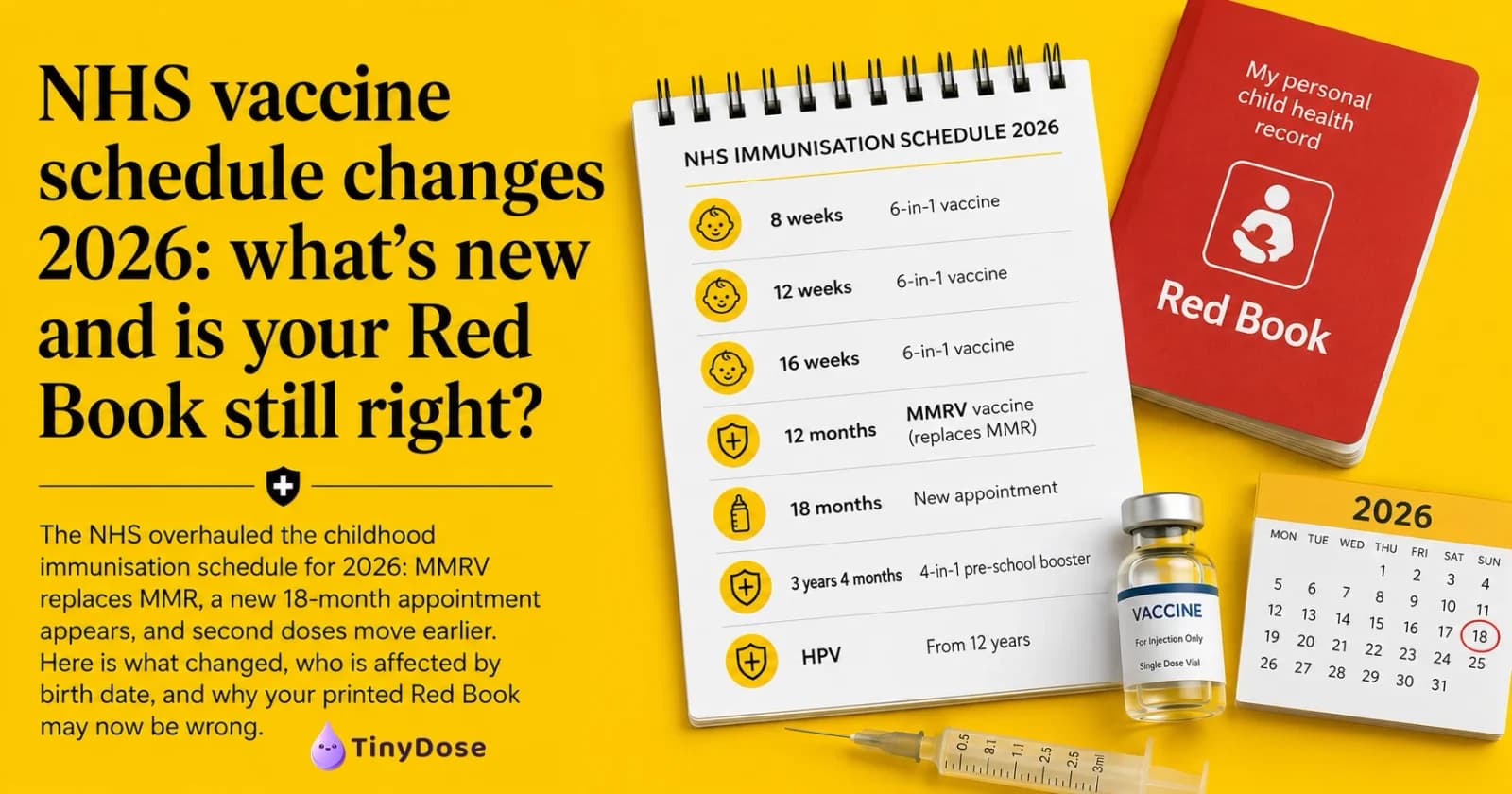
NHS vaccine schedule changes 2026: what's new and is your Red Book still right?
The NHS overhauled the childhood immunisation schedule for 2026: MMRV replaces MMR, a new 18-month appointment appears, and second doses move earlier. Here is what changed, who is affected by birth date, and why your printed Red Book may now be wrong.
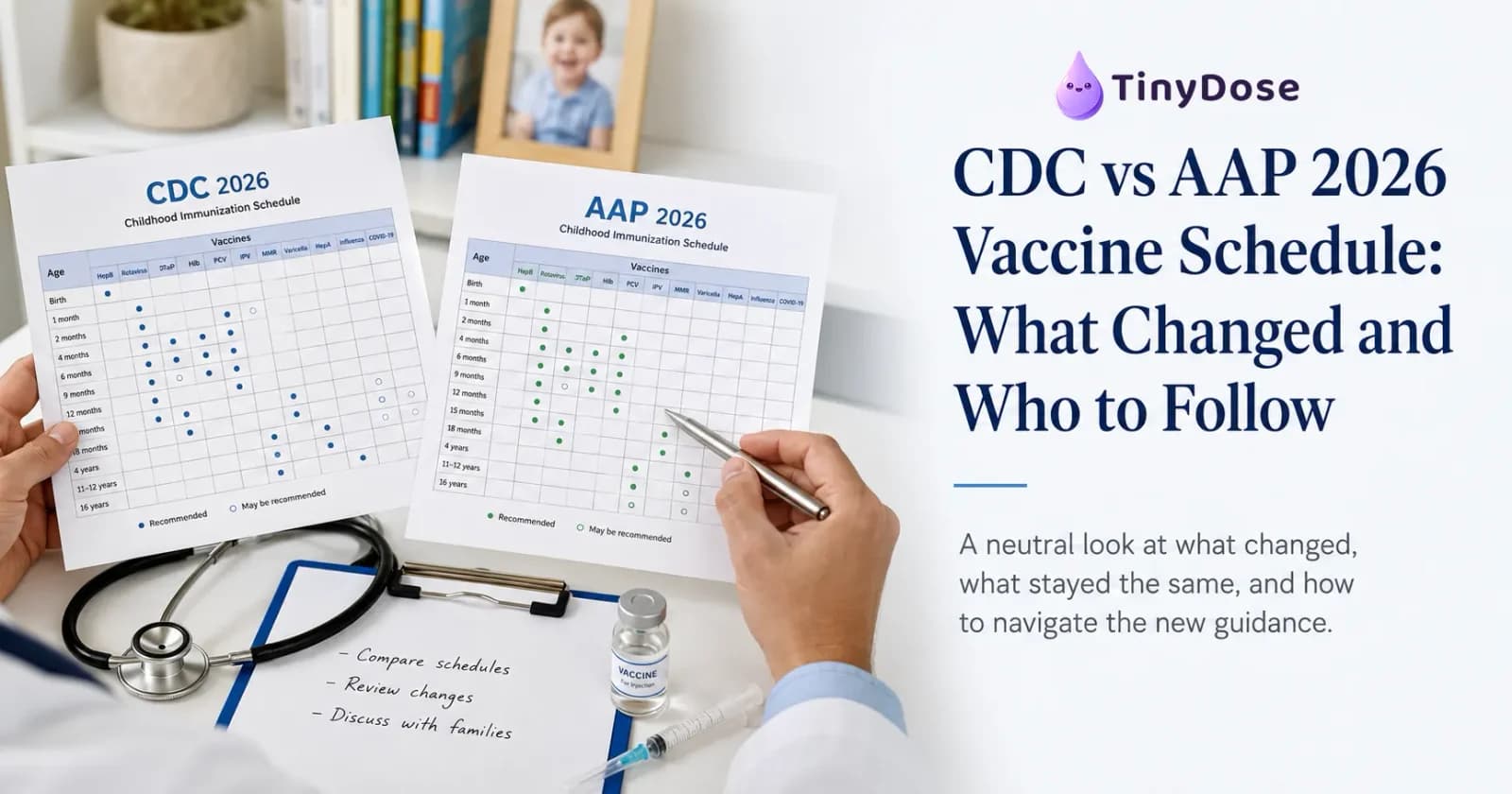
CDC vs AAP 2026 Vaccine Schedule: Which Should You Follow?
In a rare split, the CDC and the American Academy of Pediatrics have released differing childhood immunization schedules for 2026. Here is a strictly neutral look at what changed, what stayed the same, and how to navigate the new guidance.
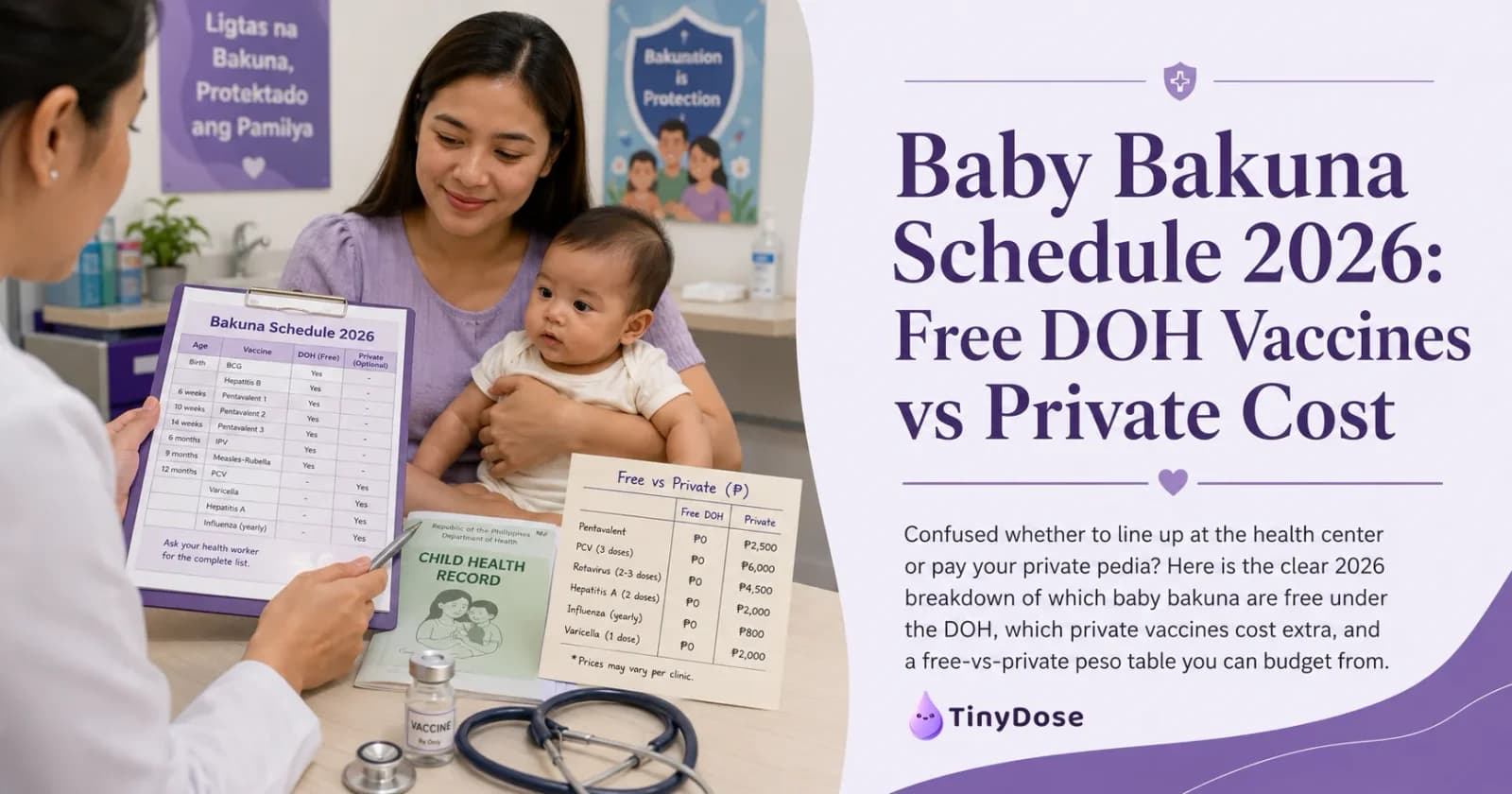
Baby Bakuna Schedule 2026: Free DOH Vaccines vs Private Cost
Confused whether to line up at the health center or pay your private pedia? Here is the clear 2026 breakdown of which baby bakuna are free under the DOH, which private vaccines cost extra, and a free-vs-private peso table you can budget from.