NHS vaccine schedule changes 2026: what's new and is your Red Book still right?
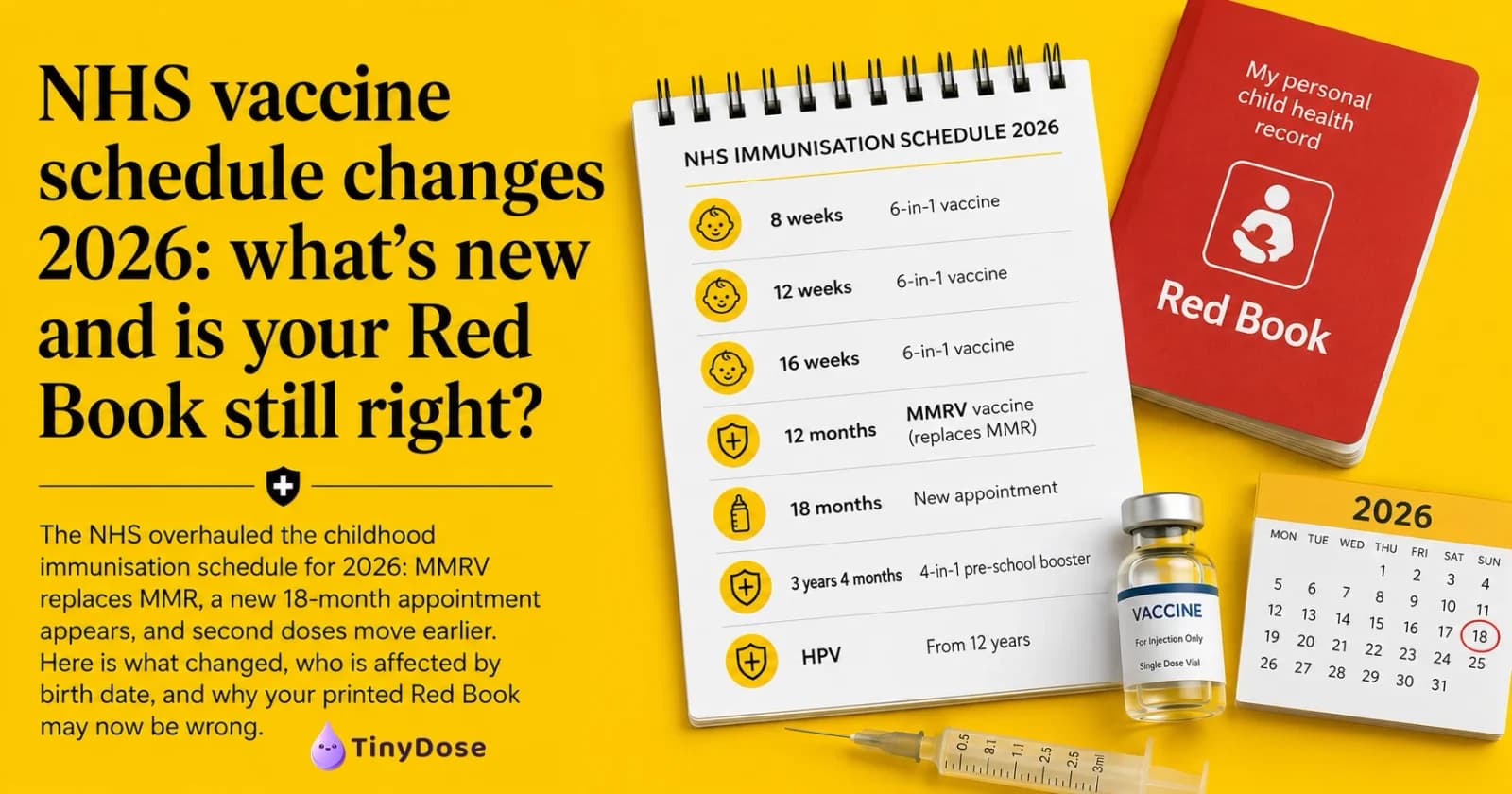
The NHS overhauled the childhood immunisation schedule for 2026: MMRV replaces MMR, a new 18-month appointment appears, and second doses move earlier. Here is what changed, who is affected by birth date, and why your printed Red Book may now be wrong.
By Renish B, Founder
If you have a child under two in the UK, the physical Red Book sitting on your kitchen counter just became the health equivalent of a 1999 Rand McNally roadmap. The NHS quietly executed one of the biggest structural overhauls to the childhood immunisation schedule in over a decade. Between mid-2025 adjustments and the major rollout on 1 January 2026, the vaccination timeline has shifted, new jab combinations have arrived, and a brand-new medical milestone has been added to the calendar.
For parents accustomed to tracking milestones on paper, the sudden shift creates immediate confusion. Here is what actually changed, who is affected based on birth date, and why your trusted paper record might be misleading you.
What changed: the big headline rollouts
The UK Health Security Agency and the Joint Committee on Vaccination and Immunisation reworked the schedule to build earlier protection against severe childhood illnesses. Two major operational updates drive the 2026 schedule.
The combined MMRV jab
Starting 1 January 2026, the standard MMR vaccine was officially retired from routine infant care and replaced with the MMRV vaccine. The added V stands for varicella, commonly known as chickenpox. Instead of booking separate private appointments for chickenpox immunisation, children now receive four-in-one protection against measles, mumps, rubella, and chickenpox directly through the NHS, free of charge.
The new 18-month appointment
Historically, after the initial 12-month vaccines, parents enjoyed a long administrative breather until the pre-school booster at three years and four months. That gap has been officially closed. The NHS introduced a new 18-month vaccination appointment.
At this new 18-month milestone, eligible toddlers receive their second dose of the MMRV vaccine alongside a fourth dose of the 6-in-1 vaccine. Moving the second MMR-type dose forward from three years old to 18 months dramatically improves early immunity rates across the population.
Earlier mid-2025 schedule tweaks
These changes follow preliminary adjustments made on 1 July 2025. The second Meningococcal B (MenB) dose was pulled forward from 16 weeks to 12 weeks to protect infants earlier against meningitis B, while the pneumococcal (PCV) dose shifted to 16 weeks.
Who is affected: the birth date eligibility matrix
In public health, schedule changes rarely apply as a blanket rule to every child simultaneously. Eligibility depends strictly on when your baby was born.
- Children born on or after 1 January 2025: This group receives the full new routine schedule, with dose one of MMRV at 12 months, followed by dose two of MMRV at the new 18-month appointment.
- Children born 1 July 2024 to 31 December 2024: These toddlers had their 12-month MMR vaccine under the old system. They attend the new 18-month appointment for an MMRV dose and a 6-in-1 booster, then receive an additional MMRV dose at pre-school.
- Children born 1 September 2022 to 30 June 2024: This cohort stays on the original timeline for their first year, but will get one dose of the new MMRV vaccine at their 3 years 4 months appointment instead of the old MMR.
- Selective catch-up cohort (born 1 January 2020 to 31 August 2022): For older children who missed out on chickenpox protection, GP practices will run a targeted single-dose MMRV catch-up campaign between November 2026 and March 2028, for those who have not had chickenpox or two private varicella shots.
Why your Red Book is probably wrong
Paper products suffer from a fundamental engineering flaw: they do not update over the air.
If your Personal Child Health Record (the Red Book given to you at birth) was printed before these schedule changes were finalised, the tables inside reflect legacy policy. Your book likely shows:
- The second MMR dose listed at 3 years and 4 months instead of 18 months.
- No entry column or tracking box for an 18-month appointment.
- MenB scheduled at 16 weeks rather than 12 weeks.
- Zero mention of chickenpox or MMRV.
This creates an obvious mismatch. When your GP surgery texts you to book an 18-month appointment, you flip open your Red Book, find no mention of an 18-month visit, and assume someone at the clinic made a mistake. The clinic is correct; your printed booklet is simply running outdated firmware.
While the NHS is supplying paper replacement inserts for surgeries to hand out, loose sheets of paper have a knack for disappearing into changing bags.
Upgrading beyond paper records
Relying on static paper for dynamic medical schedules introduces operational risk no busy parent needs. Missing a newly added appointment, or double-booking a booster based on outdated printouts, leads to unnecessary stress and delayed protection.
This is precisely why shifting to modern digital tracking is becoming essential for UK families. Digital reminder tools adapt to national schedule updates in real time. By calculating requirements based on your child's exact birth date, TinyDose eliminates the guesswork, notifies you when new NHS appointments open up, and helps ensure your child stays protected on the latest medical timeline.
Common questions
What changed in the NHS vaccine schedule for 2026?
- From 1 January 2026 the routine MMR vaccine was replaced by the combined MMRV vaccine, which adds chickenpox (varicella) protection. A new 18-month appointment was added, at which eligible children receive their second MMRV dose and a fourth dose of the 6-in-1 vaccine. Earlier, on 1 July 2025, the second MenB dose moved from 16 to 12 weeks and PCV moved to 16 weeks.
Is my child's Red Book still correct after the 2026 changes?
- Possibly not. Red Books printed before the change reflect the old schedule, so they may list the second MMR dose at 3 years 4 months instead of 18 months, show no 18-month appointment, list MenB at 16 weeks, and make no mention of MMRV or chickenpox. If your booklet and your GP's reminders disagree, the GP surgery is following the current schedule.
Which children are affected by the new MMRV and 18-month appointment?
- It depends on birth date. Children born on or after 1 January 2025 follow the full new schedule (MMRV at 12 and 18 months). Children born 1 July to 31 December 2024 attend the new 18-month appointment for MMRV and a 6-in-1 booster. Children born 1 September 2022 to 30 June 2024 get one MMRV dose at 3 years 4 months. A selective catch-up runs November 2026 to March 2028 for some children born 1 January 2020 to 31 August 2022.
Keep reading

Missed your baby's vaccine? Catch-up schedule and what to do next
A missed dose almost never means starting the series again. Here is the age-wise catch-up guide, the handful of vaccines that have a real deadline, and the exact steps to take this week.
CDC vs AAP 2026 Vaccine Schedule: Which Should You Follow?
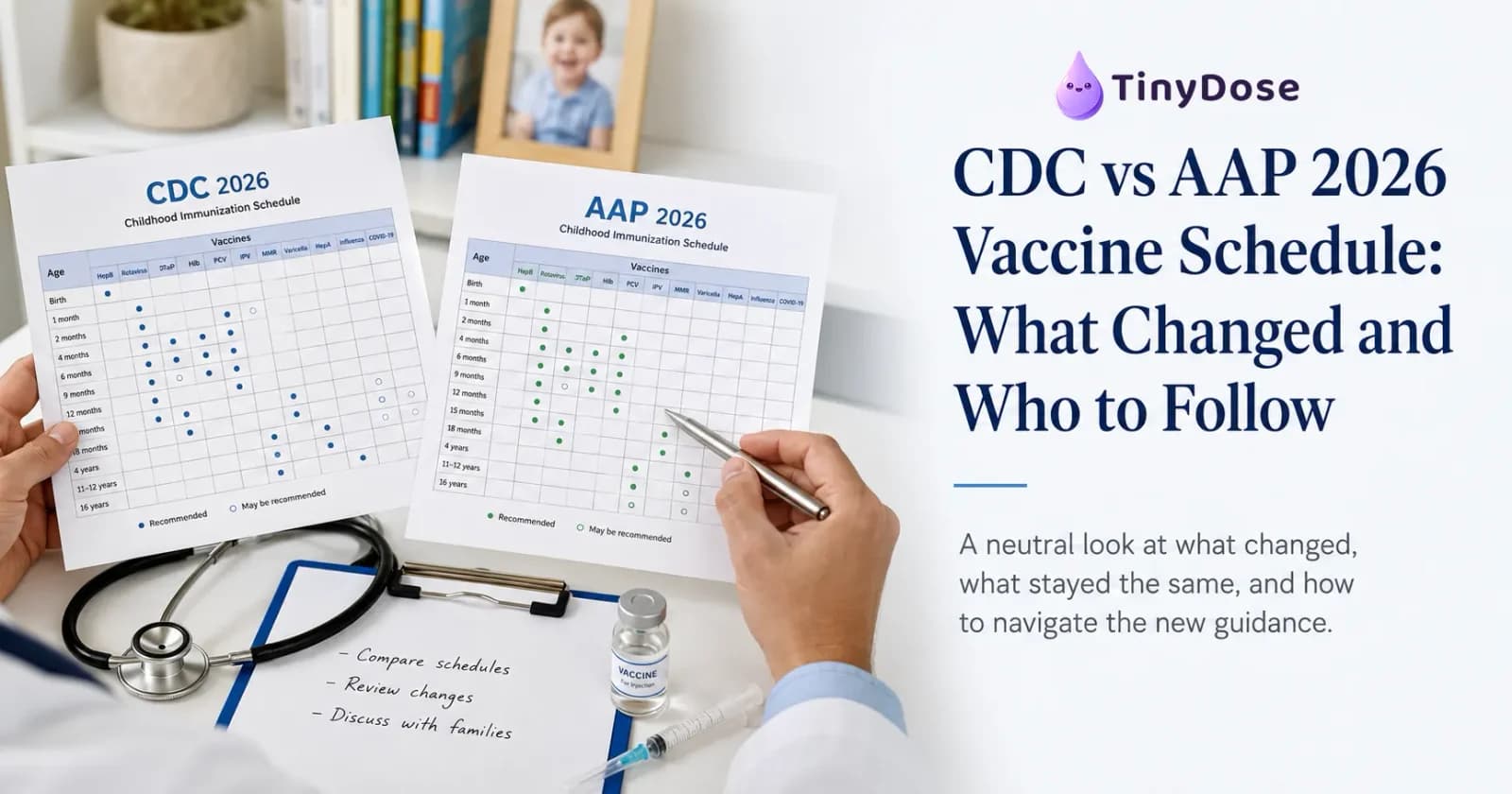
In a rare split, the CDC and the American Academy of Pediatrics have released differing childhood immunization schedules for 2026. Here is a strictly neutral look at what changed, what stayed the same, and how to navigate the new guidance.
Baby Bakuna Schedule 2026: Free DOH Vaccines vs Private Cost
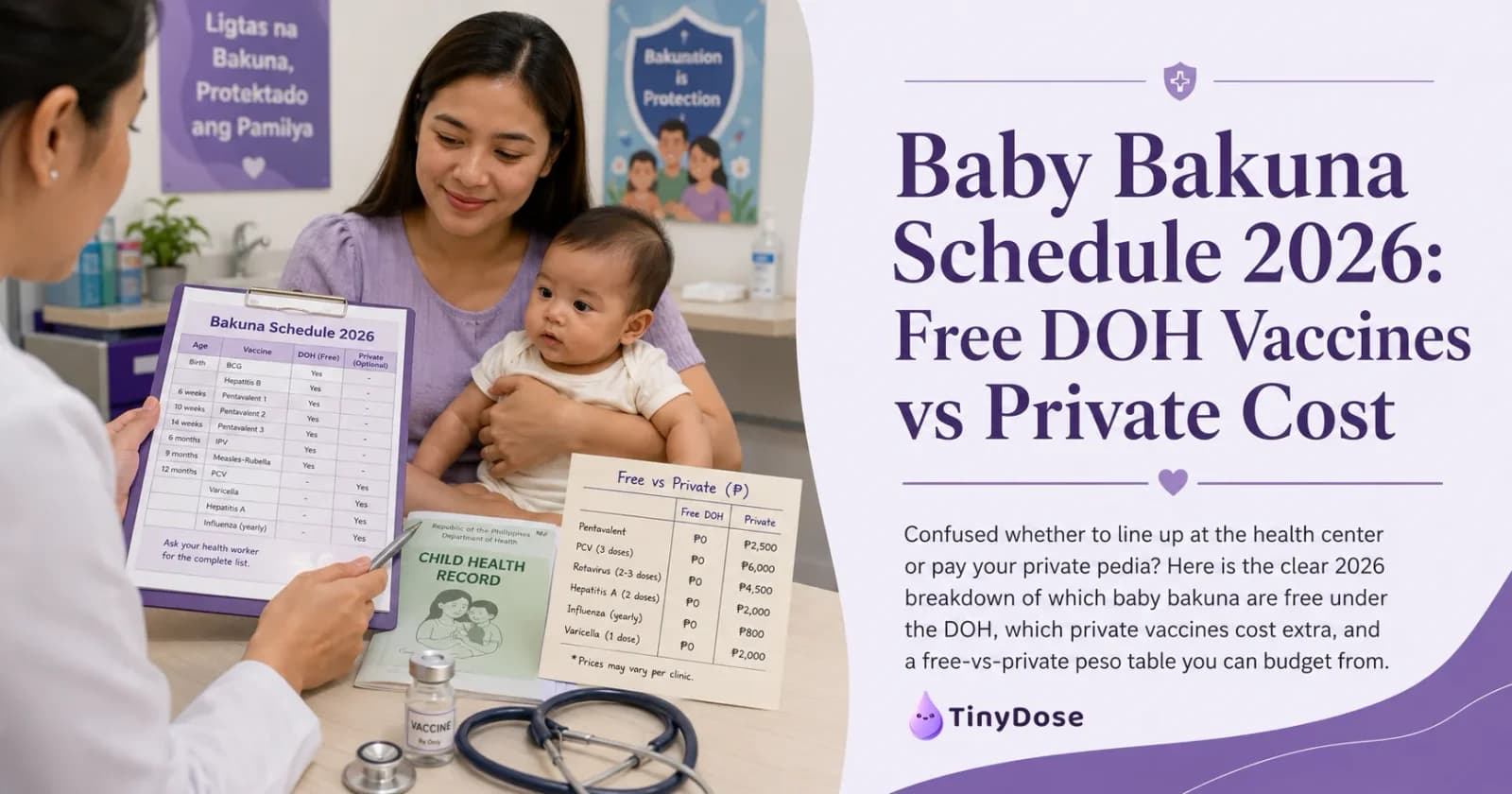
Confused whether to line up at the health center or pay your private pedia? Here is the clear 2026 breakdown of which baby bakuna are free under the DOH, which private vaccines cost extra, and a free-vs-private peso table you can budget from.